

2026 ≠ 2016—At Least in Tech
What the #2016 trend reveals about Tech Industry Culture amid the AI boom

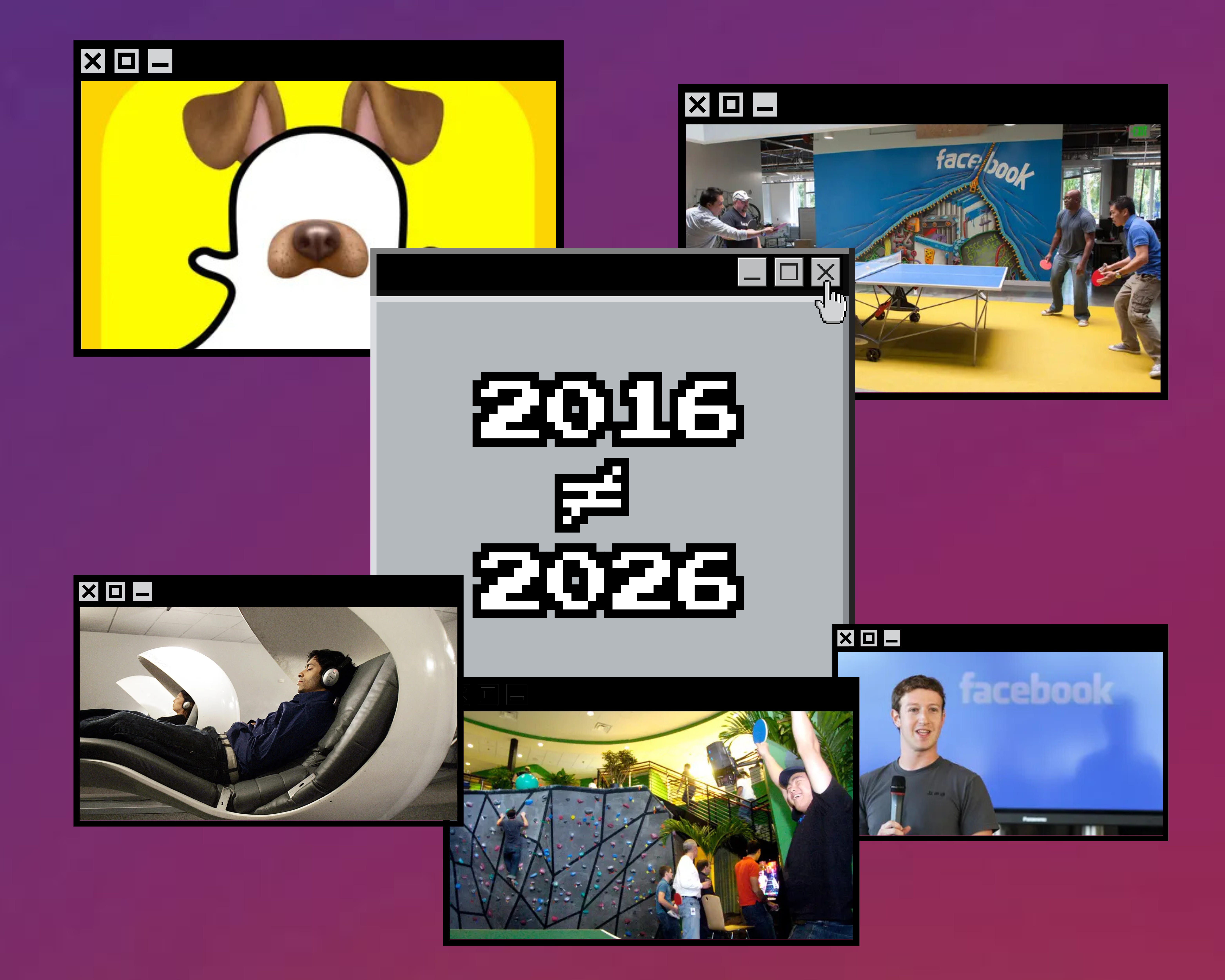
Is 2026 really the new 2016?
The first weeks of 2026 saw a viral trend emerge, celebrating 2016 as a seemingly simpler, more optimistic time. The #2016 trend dominated social media platforms like Instagram and TikTok with visual hallmarks of a bygone era: old, cringey Snapchat puppy filter selfies, and overly saturated Starbucks posts took over the internet as users declared, “2026 is the new 2016.” The BBC reported that searches for “2016” on TikTok increased sharply in the first weeks of 2026, and over 55 million videos were created using 2016-style filters like Instagram’s Rio De Janeiro.
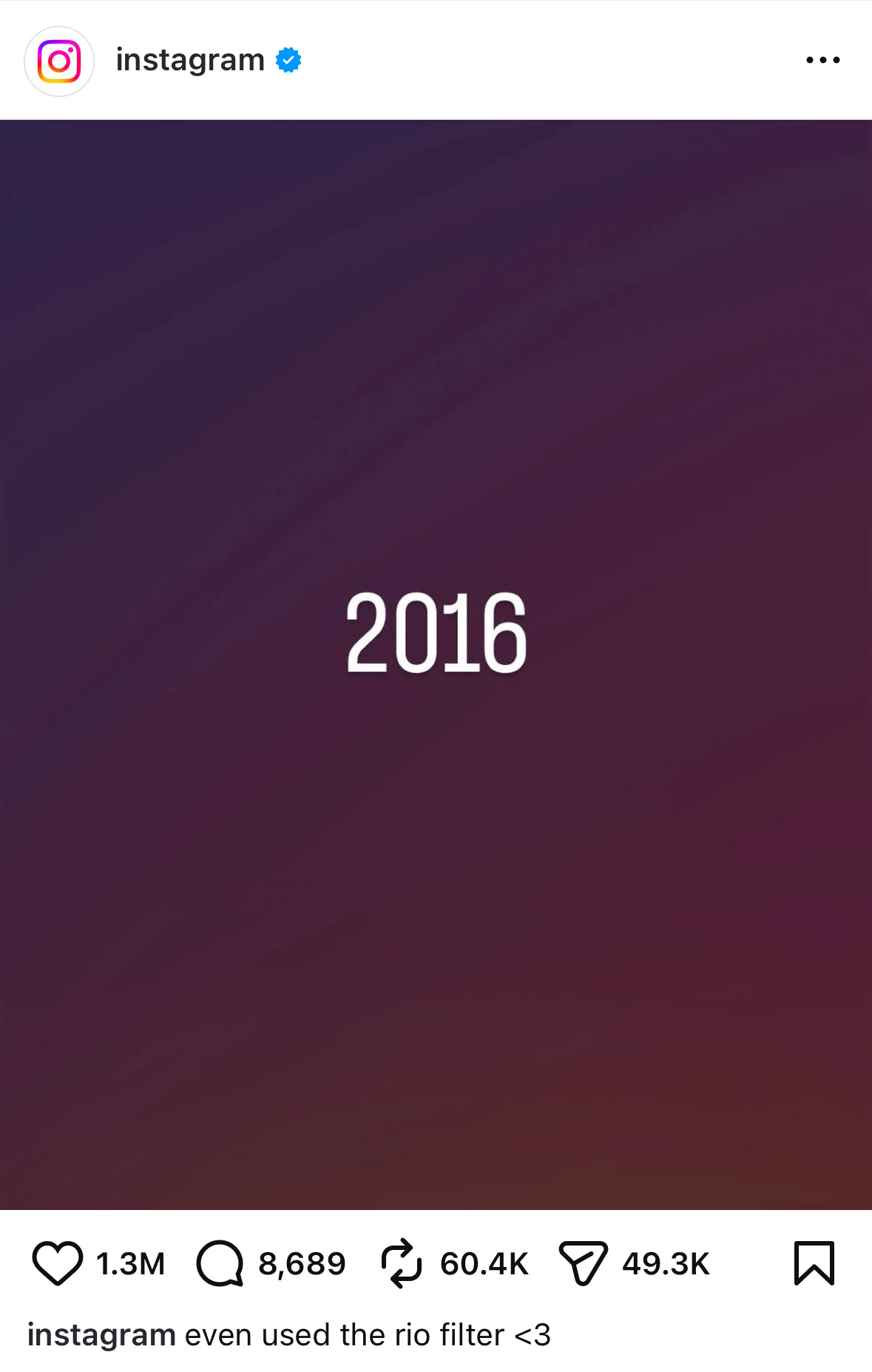
But what’s driving this nostalgia? Is it merely an arbitrary Gen‑Alpha meme, reclaiming digital ephemera from a period they barely even remember, or does it reveal something deeper about today’s tech landscape?
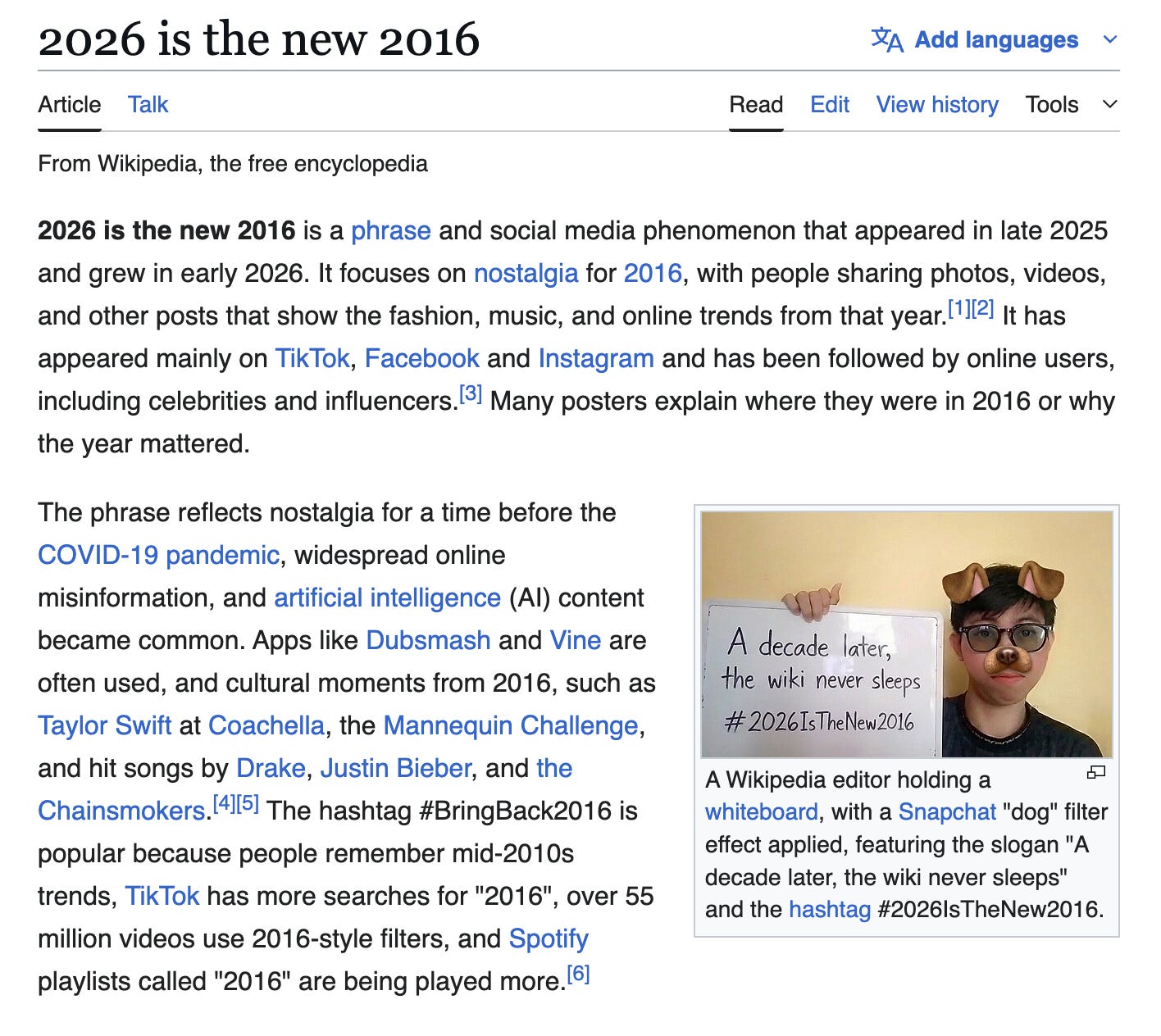
The newly unleashed 2016 romanticism may be more than just visual aesthetics. It is perhaps a longing for a lost techno-optimism in the age of AI. It harks back to a time before words like “algorithm,” “doom‑scrolling,” and “AI slop” entered our collective vocabulary — before Instagram replaced its chronological feed with an algorithmic one, and before AI‑generated degradation and hyper‑targeted ads turned social media into what Cory Doctorow calls the “enshittification” of platforms.
One of the most vivid signifiers of that techno‑positive era was the attitude toward Silicon Valley startup culture, when a job at a big‑tech firm felt like an absolute dream. Work perks like meal cards for high-end cafeteria food, ping-pong tables, Buzzfeed-style office parties, and the notorious Google nap pods helped craft the “nice‑guy” Silicon Valley culture of the 2010s. Leadership used these benefits to shape a positive corporate image while subtly encouraging longer hours. As a 2011 Wharton research report observed, “The idea was often two‑fold: (a) make the company an attractive place to work, and (b) make it easy for employees to work long hours.”
Today, that “nice‑guy” façade is fading. Companies are shedding the perk‑driven culture in favor of relentless performance metrics and a race to dominate the AI frontier. In the 2010s, tech workers wielded far more leverage—they could push for better working conditions and higher‑quality user experiences. The New Yorker noted that tech products were once good because of “…moral pushback from tech workers, who were once in such high demand that they could hold their corporations hostage with the threat of quitting.”
However, for many, AI has shattered the romantic perception that once cloaked Silicon Valley (except for the hardcore techno-optimists faithful to the idea that AI will be our saving grace). Landing a job at a FAANG company is as competitive as the race to build the world’s first superintelligence. Many leaders at this year’s Davos Summit have echoed concerns over AI’s impact on the labor market. While AI investment soars, employers have scaled back and asked employees to buckle up for the ride.
As the world’s youngest look back to 2016, the tech industry does not seem to be drawing on its former identity. Instead, the costly surge in AI investment is pushing Silicon Valley farther from its earlier, perk‑driven culture, making it increasingly authoritarian and metric‑obsessed—an environment that leaves little room for the kind of worker‑led agency that once defined the era.
This month, Business Insider reported that 2026 is shaping up to be the “show‑your‑work” year for Silicon Valley — and it’s easy to see why. With pressure for returns on AI investments, firms have rolled out extensive monitoring: metrics, dashboards, and surveillance that keep employees tightly controlled. Massive layoffs, rigid oversight, and cuts to entry‑level positions signal a new culture at the biggest AI firms. Shiny perks no longer lure talent; instead, only the most valuable workers become bargaining chips in the race to claim the most coveted spots on the AI‑building stage, while the rest of the workforce lives in constant fear of replacement.
Take Meta, for example, which recently announced large-scale layoffs affecting around 10% of its Reality Labs (Metaverse) division—a move that follows the dismantling of its VR arm in favor of an AI‑first strategy. The layoffs hit employees working on Meta’s VR headsets and Metaverse platform, even as the firm pours billions into AI research.
An employee claiming to work for Meta, who said was recently laid off, shared their distress on the anonymous tech‑worker forum Blind:
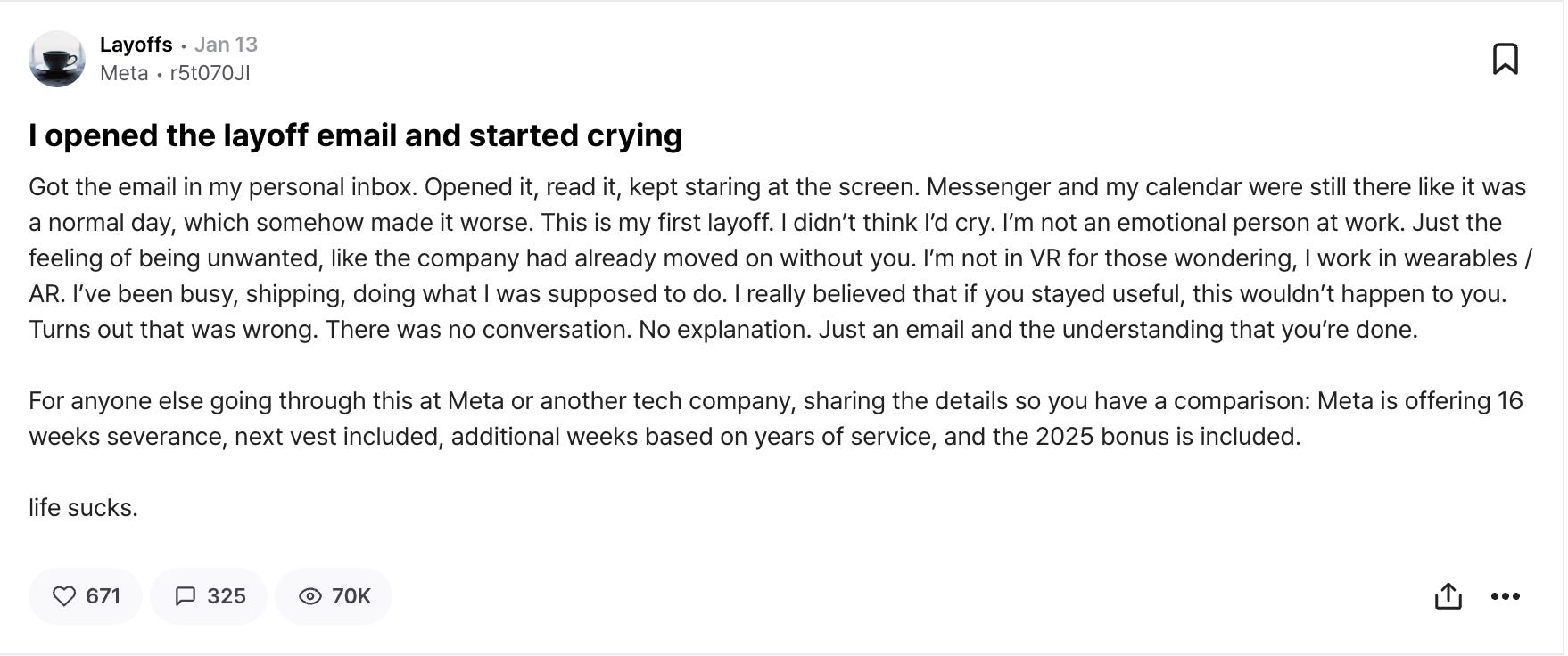
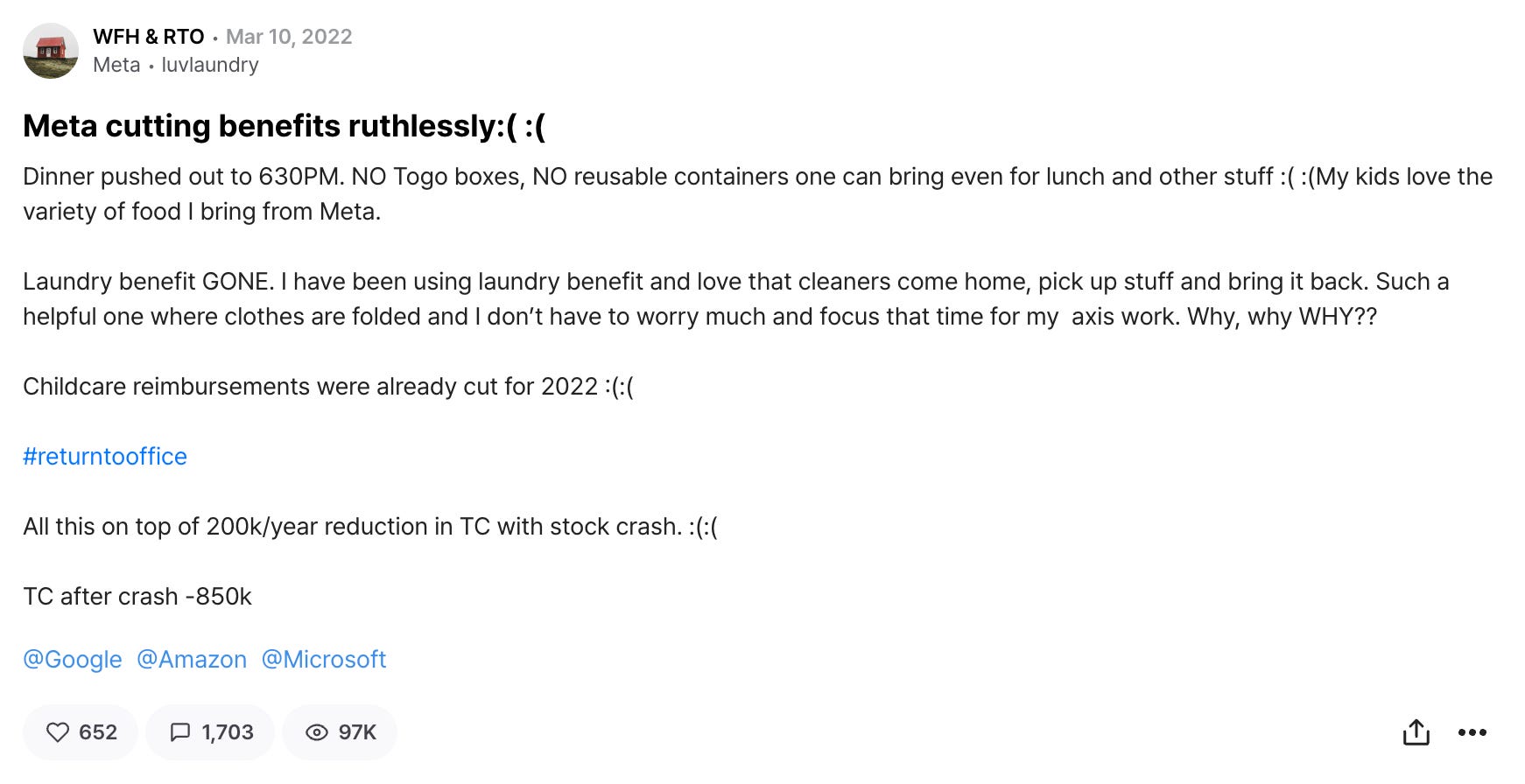
Beyond the cuts, Business Insider reported that Meta has rolled out internal dashboards to monitor every employee’s AI usage and has streamlined its performance‑review system into a stark “winner‑takes‑all” model. Using a platform called Checkpoint, the company grades workers primarily on output metrics rather than effort, handing out “gold‑star” rewards for quantifiable results. Notable company perks, such as the previous free office laundry service, have given way to relentless micro‑tracking as Meta forces its workforce to prove its worth in the AI race.
Here’s a complaint from an anonymous blind user about Meta reportedly removing the laundry perk, from someone also claiming to work at Meta:
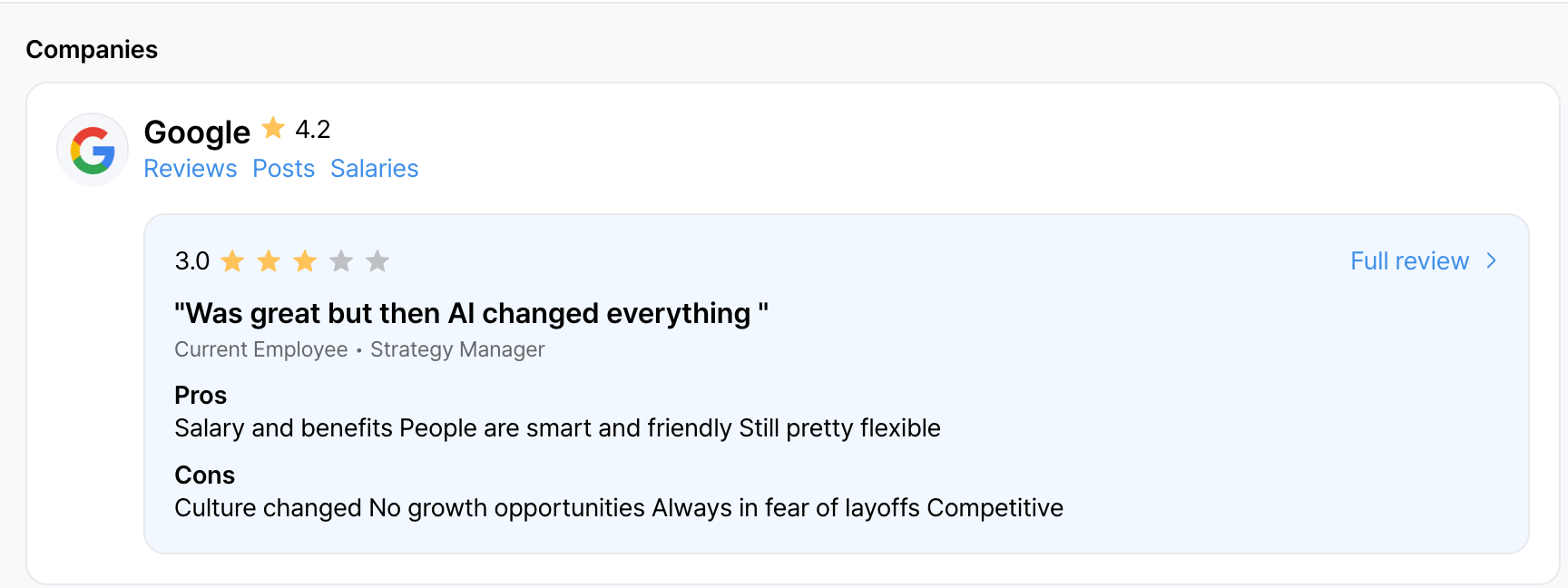
It isn’t just Meta. Business Insider notes that last year, Google overhauled its compensation system, turning it into a classic sticks‑and‑carrots model. Employees are now sorted into different performance brackets—from “Not Enough Impact” to the highest category, “Transformative Impact.” Those in the top tier receive substantially larger bonuses and equity grants, while low‑performing staff are left with modest payouts. Maybe it’s safe to say that those in the highest tier arent’t taking advantage of those nap pods…
Amazon is also following the trend. The company stepped up efforts to let managers track employee badge swipes and revised performance reviews to focus more on individual accomplishments. Managers have a dashboard to track how much time workers are spending at work — and to flag those who are brushing off the company’s return-to-office mandate. Amazon is also asking its corporate workers to provide three to five accomplishments that exemplify their work, according to Business Insider.
These changes signal a broader shift: Big Tech is morphing into a Big Brother regime, tightening performance metrics in an industry already on shaky ground. AI tools promise greater efficiency and help justify the massive spending on the technology, but they also raise expectations. Coding assistants and similar innovations create a new corporate paradigm—squeeze more output from the existing workforce and trim headcount as much as possible. The result is a workplace where relentless monitoring and quantifiable results have become the primary currency of survival.
Business Insider has dubbed the phenomenon the “Elon Effect,” a cultural shift in the tech industry to hire the best and brightest while reducing staff. Since Elon Musk’s takeover of Twitter — and the company’s ability to carry on even after deep staff cuts — tech companies have had to ask tougher questions about who is pulling their weight. That pressure cascades from senior managers down to rank‑and‑file engineers, who now face markedly higher performance expectations.
In such an environment, employees working on cutting‑edge, potentially harmful AI systems will find it increasingly difficult to raise alarms that serve the public interest. Constant performance monitoring, labor market uncertainty, and the ever‑increasing fear of being replaced by the very tools they help build leave these workers with no opportunity to report harms, if need be. The 2010s tech romanticism thrived because workers held real leverage. High demand gave engineers the confidence to push back on harmful product decisions, and many companies instituted internal “ethics review” processes to stave off public backlash. That era has faded with the onset of the AI race.
The longing for 2016 is more than aesthetic nostalgia for digital relics — it’s a yearning for a time when technology inspired hope. A pre‑AI‑hype, pre‑deepfake, pre‑enshittification era when social media was about facilitating human connection rather than algorithmic advertising. Restoring that feeling requires restoring the worker agency that once made tech feel idealistic. As Big Tech drifts toward Big Brother, confidential channels for reporting harms are more essential than ever. If powerful actors race to build ever more powerful AI, we must protect the people in the industry who are trying to steer the ship in the right direction.
So—if you’re an AI or Tech worker with concerns, reach out. We are here to help.
Psst.org supports only legal, good-faith whistleblowing with the primary purpose of protecting the public interest. Nothing in this article encourages the unlawful disclosure of trade secrets, classified information, or information obtained through illegal means (e.g. hacking).