

Raving Against the Machine: Inside the Movement Pushing Millions to Quit ChatGPT
We spoke to the people making it happen

The companies building the most powerful AI in the world were founded on a promise: this technology would be for humanity. Many of those same companies are now embedded in military contracts, immigration enforcement tools, and the political machinery of the current administration, while their executives write eight-figure checks to partisan super PACs. (Who doesn’t remember Google’s now infamous slogan “Don’t be Evil”?)
That gap between promise and practice has been widening for years. QuitGPT is just one example of what happens when enough people notice.


In a matter of months, the grassroots campaign has mobilized over four million people to cancel their ChatGPT subscriptions — one of the most visible consumer-led accountability efforts in tech history. It sits at the intersection of two things a lot of people are feeling simultaneously right now: deep unease about who is building AI and why, and a growing sense that the usual channels for holding powerful companies accountable simply aren’t simply aren't working — opening the door to something more creative, more people-led.
The movement has already morphed beyond the boycott itself, inspiring some younger participants to ditch the chatbot for the dancefloor as an expression of that same desire for change.
Whether or not you think the resistance should be danced to, or agree with every demand QuitGPT is making, the movement is worth understanding. We sat down with its organizers to find out how it started, what it’s achieved, and what it would take for them to stop.
“ChatGPT uninstalls increased almost 600% right after the Pentagon deal. Sam Altman admitted at an all-hands that the way he handled it was a mistake. Public pressure really does have an impact on the direction of these companies.”
What has QuitGPT concretely achieved so far?
We’re up to four and a half million people who have formally joined the movement through social media and the petition – that’s a huge number, and that’s incredible to us. Right after the Pentagon deal, which we were successful in publicizing, ChatGPT uninstalls increased by almost 600%. We also estimate that we have directly caused over 200,000 subscription cancellations, leading to a 1.5 billion dollar decrease in market cap. (Psst.org has not independently verified these figures.)
Sam Altman has since admitted at an all-hands meeting that the way he handled the Pentagon deal was a mistake.
Public pressure and internal employee pressure really do have an impact on the direction of these companies. We’ve also seen some big employee resignations since our launch.
We held a rally outside OpenAI’s headquarters that was really significant and a great success. It showed the kind of level of impact on the collective consciousness. We were able to show that people really care about this issue.
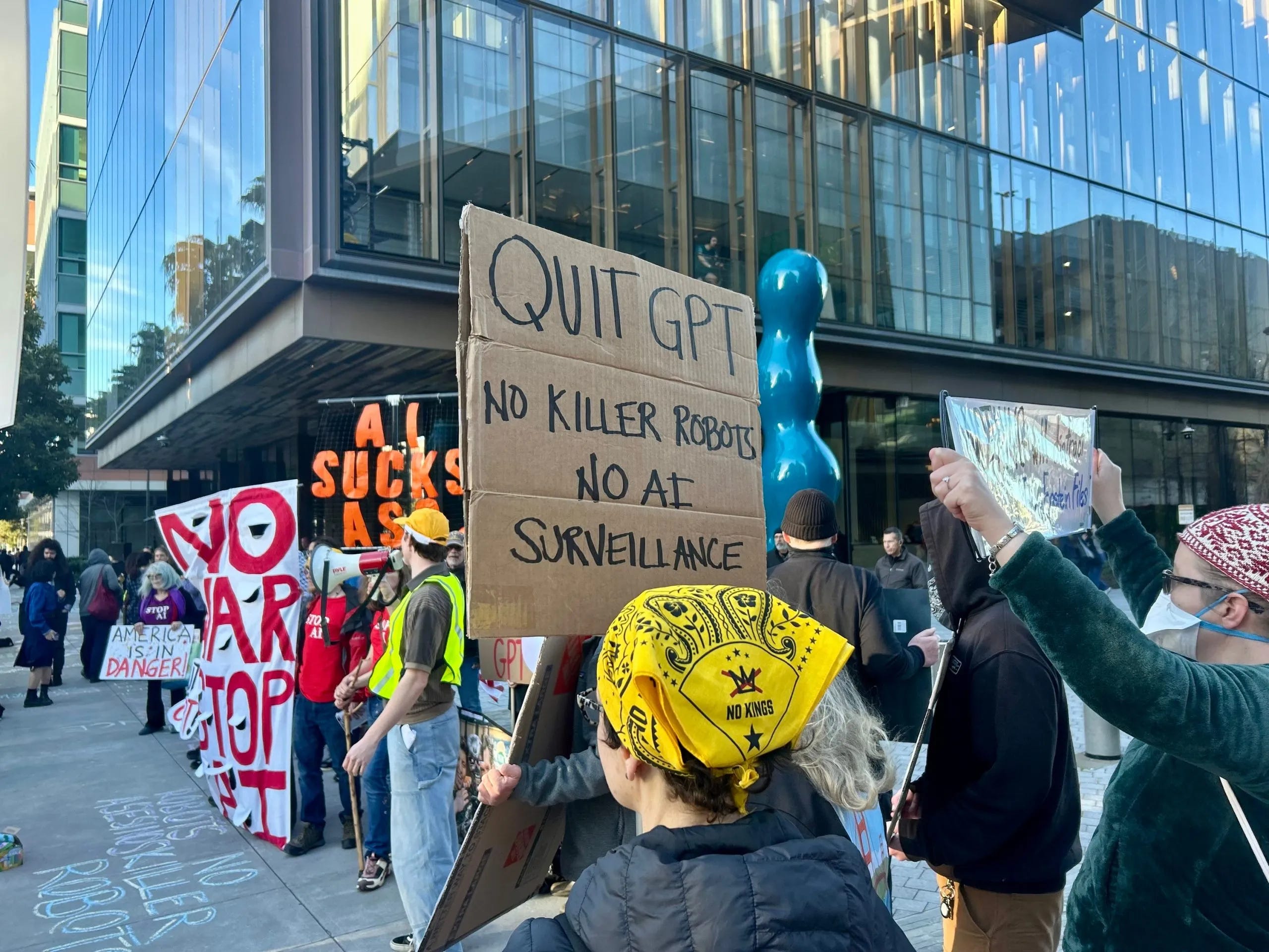
Let’s go back to the beginning. What sparked QuitGPT, and what accounts for its rapid growth?
The spark was really the Greg Brockman donation. When President of OpenAI Greg Brockman and his wife donated millions of dollars to MAGA Inc, we felt like it should have been a huge story. This company was founded as a nonprofit with a mission statement “to build for humanity,” and all of a sudden, it’s funding MAGA.
We started sharing our discomfort about OpenAI with our friends. Everyone we told was like, “Oh yeah, that’s terrible. I don’t want to support this company. I’ll just switch.”
Dutch historian and public intellectual Rutger Bregman has said, “the most effective consumer boycotts are narrow, and they are easy,” and I think that QuitGPT fits this perfectly. Once someone hears about it and becomes informed, they’re willing to act very rapidly.
We made an Instagram post or two. The first one got 20 million views. We were shocked. We had no expectation that would happen. That caused us to shift and focus a significant amount of our initial efforts on social media. That’s what really drove early growth.
Beyond organizing people to step away from ChatGPT, what is QuitGPT’s deeper mission? And what specifically are you demanding from OpenAI?
Our core goal is for OpenAI to stop enabling authoritarianism. We need to see significant proof that they are changing their current trajectory and have reoriented their internal policy to align with their own mission statement.
Here’s what we want:
OpenAI executives must commit to stopping all donations to Trump and Big Tech SuperPACs. OpenAI also needs to hold the line and refuse to allow AI for mass surveillance of Americans or lethal autonomous weapons. We’ll stop pushing the boycott only once those demands are met and verified.
These types of steps won’t be quick. But if we can show that we can hurt ChatGPT, we want to show every other major company that we can hold them accountable for similar practices.
And look, we are not an anti-AI movement. We believe that Big Tech shouldn’t have free rein on this technology. It needs to serve people.
Has the range of people drawn to this movement surprised you?
Absolutely. We’ve had mainstream democracy organizers, tech workers, college students—a real breadth of people. Actors like Mark Ruffalo, former Congressman Jamaal Bowman, Mayor Bill de Blasio, public intellectuals, and more.
On the organizer side, we’ve been collaborating with people like Scott Galloway from Prof G, who pivoted his entire #resistandunsubscribe campaign to focus specifically on ChatGPT, inspired in part by QuitGPT. He has a large following and is a prominent thinker in the economics and boycott space – that’s a huge win!
We’ve got organizers at Harvard, Stanford, Middlebury, Columbia, Northeastern, and the University of Edinburgh in Scotland. The Edinburgh case is remarkable: one person was inspired and has gathered 500 signatories urging the school to cancel a contract worth over a million dollars per year.
One story that stands out: there’s a QuitGPT rave happening at UC Berkeley?
Yes! A group at UC Berkeley called Fuzznoise is organizing a QuitGPT rave, and it is perfectly aligned with our mission of pushing back against inhumane tech. What’s more human than people getting ready to party? There’s also another QuitGPT party happening the same day in Vermont, so it’s becoming its own ongoing thing.

We do see ourselves as a new kind of movement, and we’re not taking ourselves too seriously. We don’t need to be somber about it. We literally put memes on our page.
Have you received any sort of retaliation from the industry? What has that looked like?
Not explicit threats from companies, but our website has been hacked and taken down multiple times—three or four times now. Clearly, we’re upsetting someone, and that’s definitely something we take seriously.
What pushes someone building AI from the inside to participate in a movement like this?
Having followed these companies’ progression, as many workers have, and knowing the stated goals of these companies—to build AI for humanity and for the betterment of humanity – and then watching the precipitous fall from those ideals is terrifying to a lot of people. Workers are really scared about what they’re building and who they are building it for.
We have talked to many, many people in the tech world who’ve said: “Thank you for doing what you’re doing. I might want to leave my role and join the campaign.” We’ve collaborated with several tech coalitions, and there’s been significant buy-in. That makes sense—these workers understand this tech the best. When people are aware, they become upset.
Any time you have infrastructure you can build—and QuitGPT is a great form of this—that gives workers a place to stand and say, “Look, people don’t want this,” and we’re doing something and building something people don’t want,” that’s powerful. QuitGPT is a great form of this.
At the end of the day, these companies rely on workers. Workers have immense power to change policy from within, and we hope we can act as a catalyst for that kind of change.
Tell us about the young people who have joined?
The best example is a group of high schoolers from a conservative town in Minnesota who reached out through a mutual friend. It wasn’t our idea initially, but they were so passionate that we wanted to activate them because young people are what we need.
At a recent protest, they set up a table, distributed stickers and flyers, and shared the message with everyone they could. Now they’re working to expand QuitGPT clubs across Minnesota high schools so that people at the policy level can’t ignore them and to make sure AI truly serves people.
Every time I get on a call, five more join and they’re beaming with excitement. In a time that feels hopeless, it really is quite meaningful.
Are we at a turning point in how the public thinks about AI power and accountability?
I think there are several factors that make this movement resonate in this particular moment. People are deeply concerned about democratic backsliding—and for good reason. They’re worried about the trajectory of AI specifically: warfare, surveillance, authoritarian control. But what really hits home is connecting those dots—showing how AI fears are inextricably linked to the threats we’re facing in the US right now. That’s why people act.
We are absolutely at a turning point. The broad public is waking up to both the revolutionary potential and the grave risks of AI. People are realizing we can’t just trust these massive companies to act morally on their own—we have to fight back. We will boycott them, we will organize, and we will put relentless pressure on them and on regulators.
We’re on a mission to prove something fundamental: there is massive consumer power behind the demand for ethical AI. We’ve had success because there is widespread demand for people-first AI and people-first democracies. There needs to be more movements like ours. And we’re looking to expand as much as possible to amplify that message.
The views expressed in this interview are those of QuitGPT’s organizers. They do not necessarily represent Psst.org’s positions.
Psst.org is a nonprofit that helps tech workers disclose public-interest information safely. If you’ve seen something at work that concerns you, request a pro bono consultation with one of our lawyers via our Safe. All conversations are confidential.
I love Psst and think it has a very important role to play in keeping government and the corporations that own them accountable. However, ChatGPT came out during the Biden Administration in 2022. Making this about President Trump, whom I am not a fan of, seems disingenuous and makes Psst appear biased. Fraud under Trump is shouted from the rooftops but the massive fraud under Walz and Newsome are defended. Bias undermines the credibility of any organization. ChatGPT tied to Trump? You may want to back that up and tie it to the right doghouse: Biden.
My Advice on How to resist big tech. Divest, Resist, and Unsubscribe.
https://turingpolice.substack.com/p/dont-resist-and-unsubscribe-divest